








|
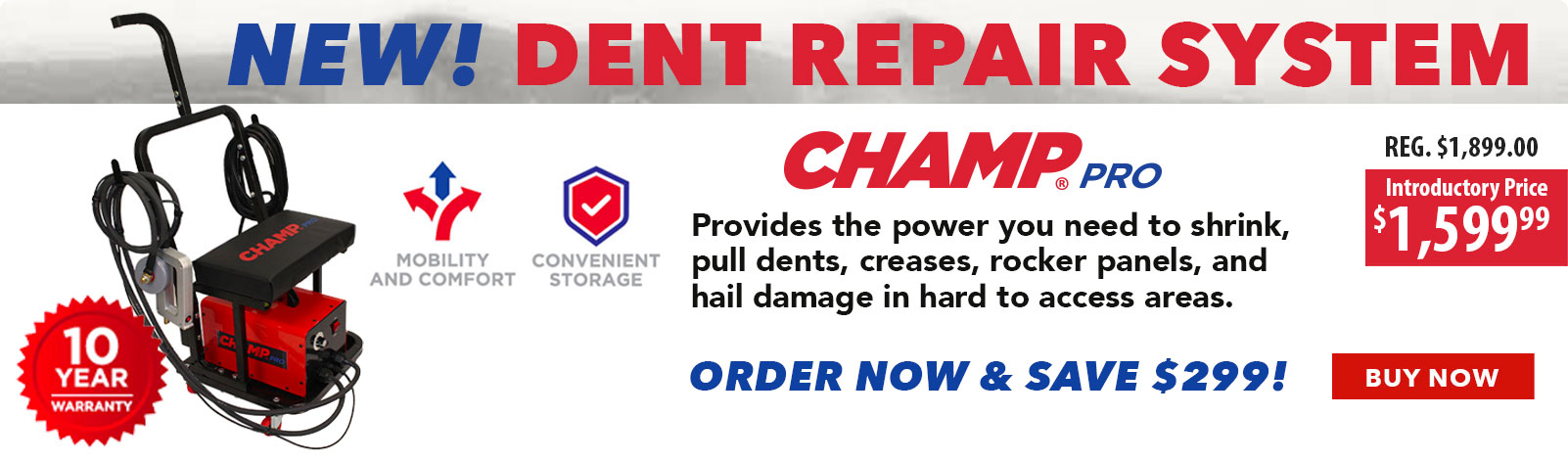
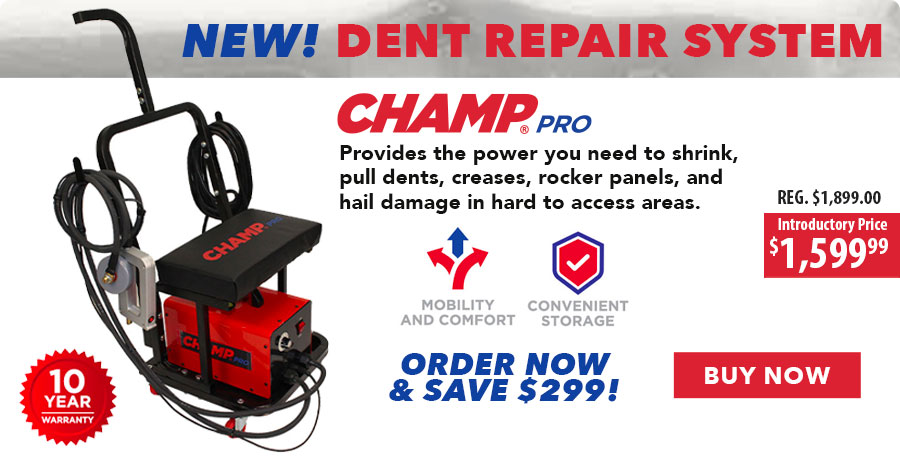
“The Champ”
Knock
Out – Dent Removal System Part #1540
INSTRUCTIONS
FOR CONNECTION, SAFE USE AND MAINTENANCE
OPERATING SPECIFICATIONS
Primary
input
110 Volt
Primary
Amps
20
Duty
Cycle
2.0%
Output
2.2kva
Manufactured
in the United States of America Specifically for Auto Body
Tool Mart
Safety
Instructions:
1.
READ
ALL INSTRUCTIONS CAREFULLY.
Before connecting or operating the tool.
2.
ALWAYS
WEAR SAFETY GLASSES.
Use a dust mask if the operation creates dust.
Caution is the key to safety.
3.
PROTECT
YOURSELF FROM NOISE.
Noise levels vary with work.
If noise level is high, wear ear protection.
4.
WEAR
GLOVES AND PROTECTIVE CLOTHING.
To avoid injuries form hot metal chips.
5.
ONLY
USE ACCESSORIES THAT ARE DESIGNED SPECIFICALLY FOR THIS
TOOL.
Modifications to this tool may cause injury and may cause
the tool to malfunction, voiding any warranties.
6.
HANDLE
THE TOOL SAFELY.
Do not operate the tool if it is damaged or in a wet
condition.
7.
WHEN
NOT IN USE-DISCONNECT THE TOOL FROM THE POWER SUPPLY.
8.
DO
NOT ALTER ANY PART OR COMPONENT OF THIS TOOL IN ANY WAY,
SHAPE OR FORM.
OPERATION:
- READ
ALL SAFETY INSTRUCTIONS
- Grind
paint or rust from area to be worked on.
It is important that the panel be clean to bare
shiny metal for good weld contact.
Attach the ground cable to a bare metal surface
on the same panel that is to be repaired.
Never allow the welding electrode to make contact
with the grounding clamp.
A magnetic grounding clamp has been provided,
please make sure that the ground is kept clean and free
of metal debris that will be attracted.
Ground must be kept quality will be
lessened.
- Plug
the power cord into appropriate 110-volt outlet and flip
switch to on position.
- Select
appropriate pull electrode:
Short rod in conjunction with lever puller or by
itself for straight pulls by hand.
Long electrode in conjunction with slide weight
may be purchased separately for heavier damage.
The copper electrode is used for shrinking and
applying wiggle wire.
Wiggle wire is used for pulling creases evenly.
This item may be purchased separately.
Please contact customer service for further
details.
- Always
start welding with minimum welding time.
Increase weld time only when necessary.
Long electrode may need a slight increase in weld
time over the short rod.
Wiggle wire of 1/16 (.60).
Thickness should be welded with a shorter time
than 3/16 (.90) wire.
When proper weld time is used it will be very
easy to remove the wire by simply wiggling it up and
down.
Shrinking
can be done with the attached wiggle wire electrode on top
of the pull handle. Use
the wiggle tip when only a few high spots need shrinking.
Wetting the panel with a spray bottle first can enhance the
shrinking effect. As
with anything, practice and experience will lead to greater
control.
Longer
weld times do not increase adhesion of the pull rods
and wiggle wire.
Note: Extensive shrinking may cause
the unit to overheat.
The transformer has a temperature fuse and will switch off
temporarily.
After
welding, the best way to break off the pulling rod
is by twisting.
Wiggling from side to side may cause a hole
in the panel.
Wiggle wire is removed by rocking up and
down.
|
Dent Pulling
- Turn
the machine on.
- Touch
the narrowed end of the electrode against the exposed
and clean metal at the precise point where you want to
begin pulling and then press the button located on the
handle. The
electrode will then be welded onto the metal ready to be
pulled.
DO NOT ROCK OR TILT THE ELECTRODE ONCE IT IS ATTACHED
TO THE METAL AS THIS WILL WEAKEN THE WELD AND IMPAIR THE
PERFORMANCE OF THE UNIT
- Small
dents such as hail can be pulled “free-hand” without
the use of the leverage bar.
Once the electrode is attached to the bottom of
the dent, firmly pull the handle directly away from the
panel while simultaneously taking a bodyman’s hammer
in the other hand and tapping on the high spots on the
perimeter of the dent.
Continue this tapping process until the dent is
pulled to the desired position.
- To
remove the electrode, a simple twist left or right while
holding the handle will break the contact to the panel.
- Repeat
the process until the panel is pulled to your
satisfaction.
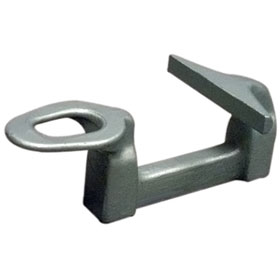
USING THE LEVERAGE BAR
The leverage bar is generally, the easiest
way to pull most dents.
The leverage bar, when used correctly, allows you
to finesse a damaged panel back to an original state.
- With
the leverage bar in one hand, place the padded foot on
the sturdiest section of metal closest to the desired
pull point as is possible.
- Using
the other hand, hold the handle and place the electrode
through the two rails of the leverage bar, ideally 3”
to 6” away from the foot.
- Gently
pull up on the handle of the leverage bar until the spot
is pulled out as desired.
When using the leverage bar, make sure the
electrode is pulled straight back from the metal and not
at an angle.
- The
same hammer-tapping technique on high spots can be used
with the leverage bar.
While
using the tool it is periodically necessary to clean and
regrind the tips of the pull rods.
The tips are not being worn down, but actually are
adding material that needs to be removed.
The rods work better with a sharpened point of 3/32
to 1/8 of an inch across the top.
GENERAL MAINTENANCE
“
The Champ”
contains no customer serviceable parts.
Only a qualified electrician should open the unit.
Electrode tips will need to be cleaned and
occasionally replaced.
Bear
Claws are purchased separately.
|